

Foreign Perspectives is a mix of free and paid content. Certain columns such as these are free for all subscribers, but other articles will be exclusive for paid subscribers. If you enjoy the work I do, please consider upgrading to a monthly or yearly subscription. Your support is greatly appreciated and ensures that this Substack can continue to deliver high quality pieces.
Note: This review is spoiler free.
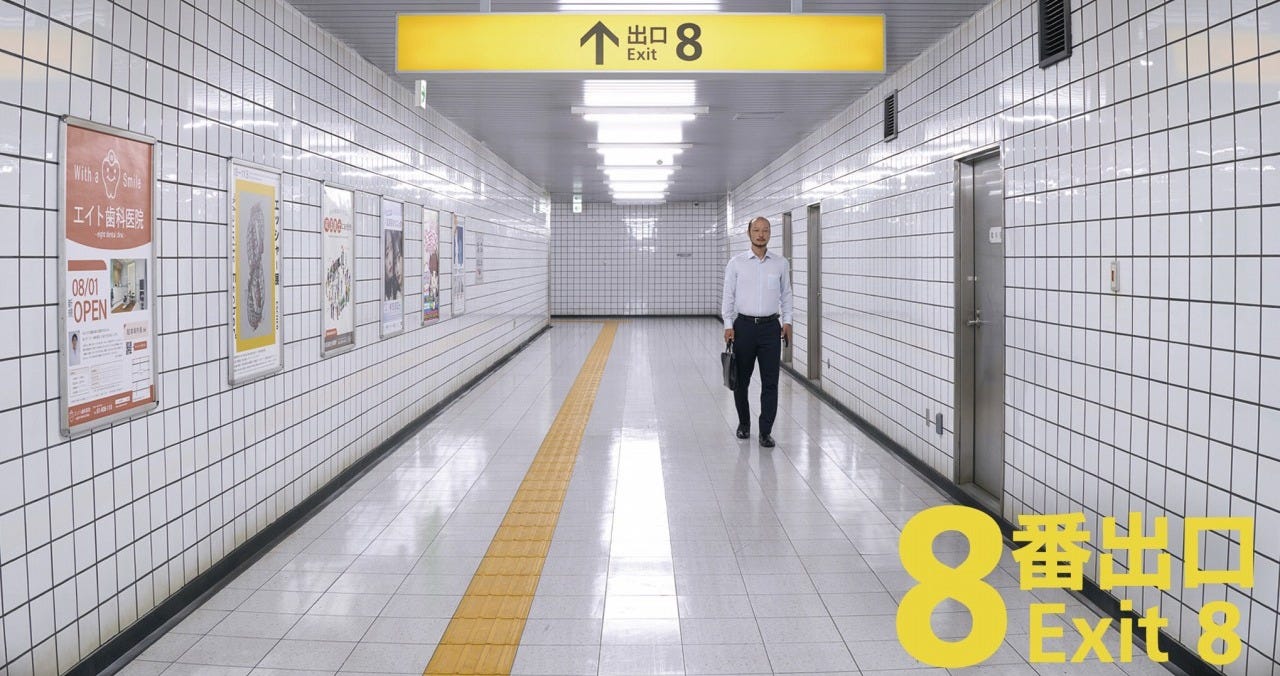
Polished white tile floors and ceiling. Walls lined with posters advertising an assortment of jobs and services. A hallway that appears to go on forever. Unnerving ambiance. Wandering middle-aged salarymen. This mundane setting could describe any one of Japan’s hundreds of underground metro stations, but most today would associate it with The Exit 8.
This viral indie video game took millions of players by storm both at home and abroad ever since it hit Steam in 2023 with a simple, yet ingenious concept. Via the first-person perspective of an unnamed commuter, players are trapped in station passageway that has no end. To escape, you must spot “anomalies” each time you maneuver through the very brief stretch of walkable space which loops to the beginning again after turning a couple of corners. These anomalies can be as small as an out-of-place advertisement or as large as a literal tsunami heading in your direction. You turn back if you spot these curious differences, but keep going if nothing seems amiss. Master the right order and you’re home free out Exit 8.

Emerging from its humble origins as a solo project by a developer named Kotake Create, The Exit 8 quickly went on to become one of the most profitable indie games of all time. Its success was so massive, it spawned a sequel, manga adaptation, a light novel, and now a film of the same name. I was out of the country when Exit 8 opened in Japanese cinemas last August, but finally got around to it this week after it was made available for rental on Amazon. It was just announced for release in the United States on April 10, so I expect there to be renewed discussion pretty soon.
I confess to missing most of the initial hype around The Exit 8 and only played it for the first time earlier this year, though you can chalk that up to my habit of being late to the party for most things. I was already aware of all the memes and parodies spawned by the game, so the concept of a cinematic take on what amounts to a walking simulator that can be cleared in about 45 minutes left me quite skeptical. Against all odds, however, Exit 8 is not only one of the best film adaptations of a video game ever made, it even enhances the interactive source material it came from.
I’ve long believed that video games and films should typically stay as separate mediums without trying to ape each other too much. As interactive entertainment, the best games use that unique element to their advantage and tell immersive narratives via player control. Films, on the other hand, are passive media and come from over a century of tradition in photography, acting, and sound design to attract audiences to their worlds. Rarely do the two mix successfully. Video games that attempt to be like movies often end up as pretentious imitators at the expense of their actual gameplay, while movies that try to adapt games are usually made by people who don’t understand or respect the medium. Even if some cinematic aspects are competent, the interactivity no longer being present can destroy what made the video game worth playing in the first place.

Exit 8 avoids these pitfalls by telling an original story set in the game’s familiar setting while being clear from the start that this intended to be a film which stands on its own. Those who know the game will appreciate a few references such as the protagonist initially doing the same things as first-time players; he tries to open locked doors, takes pictures of his surroundings to remember the anomalies, and makes mental notes to himself. That’s really where the cheeky nods end, though. With a runtime of 95 minutes, there clearly needed to be more substance than what could be found in a standard YouTube Let’s Play video.
Director Genki Kawamura wisely chooses to focus on the inner psychology of his characters. The nameless protagonist, referred to as The Lost Man, initially could be a stand-in for the millions of Japanese commuters who take the subway every morning. The opening track is Maurice Ravel’s Boléro, one of the most famously recursive compositions in musical history. The ad nauseam repetition of doing the same monotonous routine each day between a dull job and lifeless home is the obvious initial theme of Exit 8. Much could be said on how that applies to Japan in particular, but the film’s story adds effective emotional tension by establishing the central conflict as being between The Lost Man and his estranged ex-girlfriend who finds out she’s pregnant right after their breakup. Exit 8 then becomes something more introspective about unwanted fatherhood, responsibility, and societal pressure.
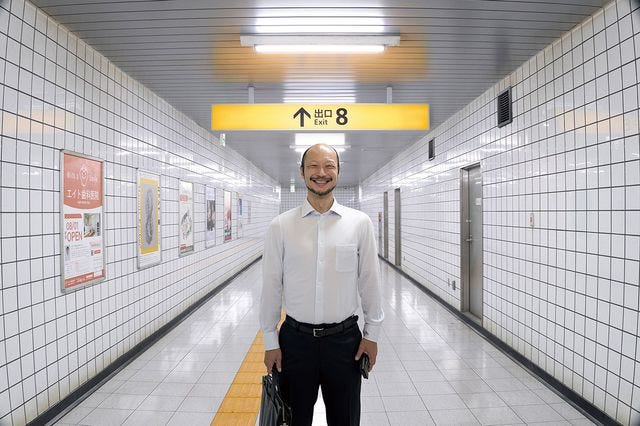
The Lost Man’s journey through the infinite corridors of the metro station can be viewed as him literally being stuck in a time loop, but the more interesting interpretation to me is viewing the whole thing as a metaphor for his own spiritual and emotional journey. Perhaps less obvious to Western viewers are the subtle Buddhist themes. The religion, which plays a large role in Japanese society alongside Shinto, has the concept of samsara or the never-ending cycle of birth, death, and rebirth. Beings trapped in this dynamic are perpetually suffering, while the chosen few who manage to escape it achieve a state of enlightenment known as nirvana.
To reach nirvana, one has to undergo the Noble Eightfold Path. This centers around following the Buddha’s teachings in the following eight areas: right understanding, right thought, right speech, right action, right livelihood, right effort, right mindfulness, and right concentration. An eternally repeating cycle of suffering and mastering eight principles to exit out of it? While no one behind the original game or film has explicitly confirmed the Buddhism connection as far as I’m aware, the similarities are too striking for it to be a coincidence. Exit 8’s short runtime means that things have to move ahead at a certain place, but pretty much all of these themes feature at some point throughout the film.

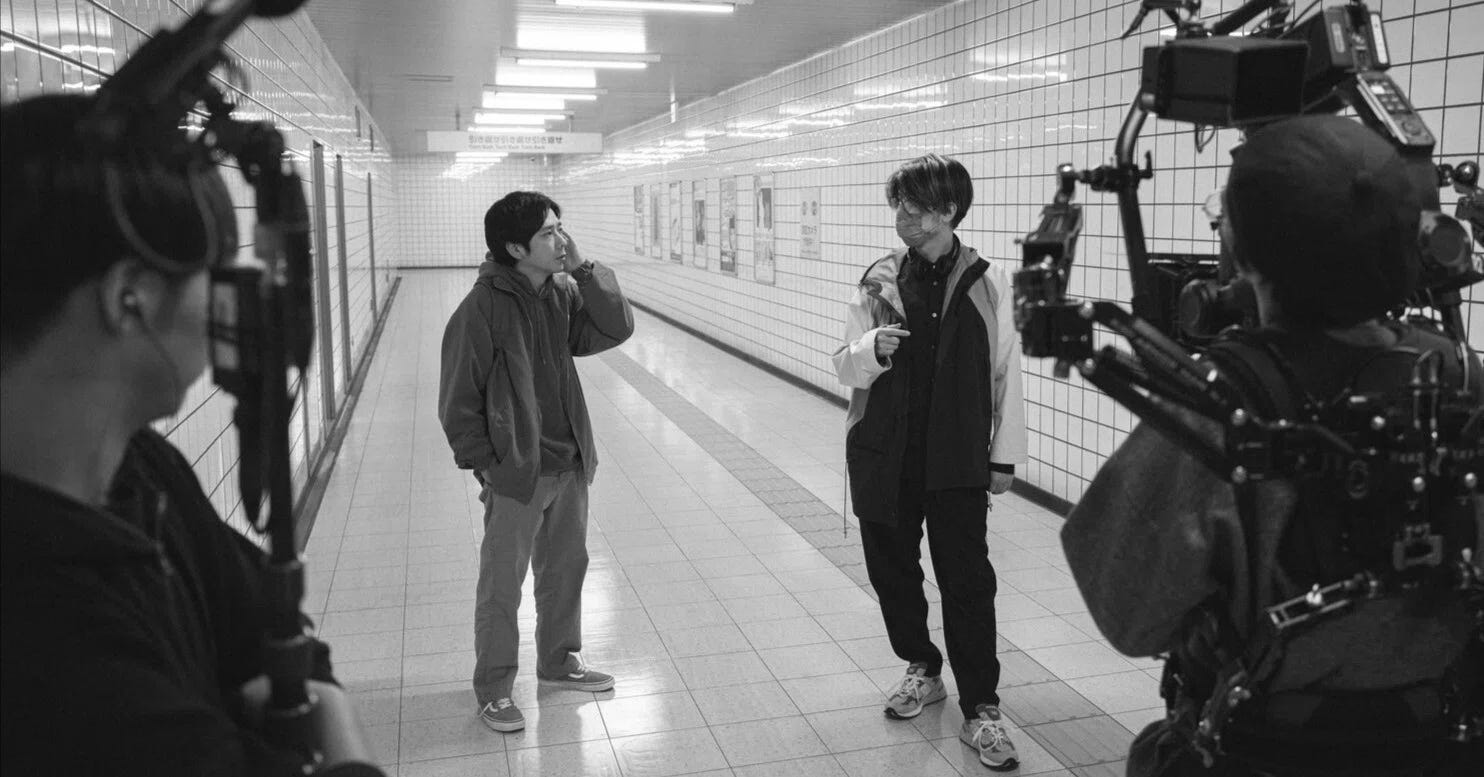
I won’t spoil how other characters play into these events or what visual surprises Kawamura includes. With that said, Exit 8 is a more thought-provoking film than your average cinematic adaptation of a video game. It even keeps much of the game’s visual language intact by going for an unbroken “one-shot” style of cinematography similar to Alfred Hitchock’s Rope and Sam Mendes’ 1917. There are obvious cuts and scene changes, but you never feel taken out of the illusion. Everything comes together smoothly by the end, and I walked away with the impression that Exit 8 was evidently made by people who cared. Kazunari Ninomiya, who plays the protagonist, is a gamer himself and actively worked with the director to ensure that everything players enjoyed was maintained.
With that said, Exit 8 isn’t perfect. Despite the intriguing themes, the characters themselves aren’t particularly interesting on their own. While the protagonist’s ordeal is palpable, I would have liked to see a tad more insight into his backstory beyond what was shown and the other characters get even fewer details. Some viewers may just find the whole thing too pretentious for its own good and the premise as more experimental rather than a baseline for a compelling film. Indeed, those who were more reserved with their assessment of the video game believed it was closer to a solid proof of concept and too brief to satisfy as a standalone work.
Still, Exit 8 regardless of medium is about audience patience and open interpretation. It’s admirable that Kotake Create attempted to do something few games apart from perhaps Hideo Kojima’s cancelled Silent Hill teaser P.T. ever explored with its creeping atmosphere of psychological horror in liminal spaces. Exit 8 as a movie expands upon that base with an engaging story, impressive cinematography, and effective sound design. Even with the interaction removed, it all largely works because the game and film are meant to be companion pieces to one another instead of the latter being a cheap pastiche of the former. With video game movies likely to replace superhero movies as the next big thing, Hollywood should take notes from Exit 8 on how to honor the source material.
Foreign Perspectives is a reader-supported Substack. If you like my work and have come this far, consider opting for a paid subscription so I can continue writing in-depth articles such as these on a regular basis. Your support is greatly appreciated!